


 Feb 17, 2026
 0 Comment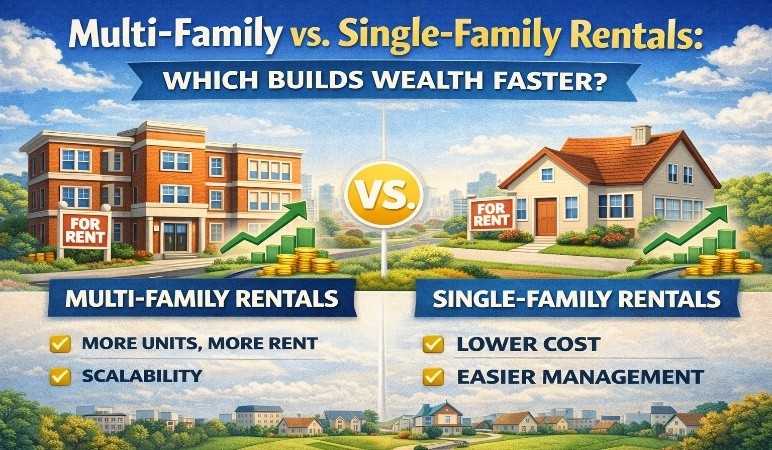
Multi-Family vs. Single-Family Rentals: Which Builds Wealth Faster?
The Great Debate in Real Estate Investing
Should you invest in single-family homes or multi-family properties? This question divides real estate investors into passionate camps. Both strategies build wealth, but they do it differently. Understanding which aligns with your goals, resources, and risk tolerance is crucial to your investing success.
This guide breaks down the pros, cons, and financial realities of each approach so you can make an informed decision.
Defining the Property Types Single-Family Rentals (SFR)
One dwelling unit on one lot. Includes detached houses, townhomes, and condos. You rent to one tenant or family at a time.
Multi-Family Properties
2-4 units (duplex, triplex, fourplex) or 5+ units (apartment buildings). Multiple rental units on one property with multiple tenants paying rent.
Cash Flow Comparison Single-Family Rentals
Typical cash flow: $100-$300 per property per month after all expenses. Lower individual property cash flow but easier to scale by buying multiple properties.
Multi-Family Properties
Typical cash flow: $200-$500 per unit per month. Higher total cash flow from one property. A fourplex generating $400/unit produces $1,600/month total cash flow.
Winner: Multi-Family for immediate cash flow
Appreciation Potential Single-Family
Appreciates based on comparable home sales in the neighborhood. Market-driven appreciation. Less control over value. Typically appreciates 3-5% annually in stable markets.
Multi-Family
Value based on income (Net Operating Income / Cap Rate). You can force appreciation by increasing income or decreasing expenses. More control over property value.
Example: Increase rents by $100/unit on a fourplex. Add $4,800 annual income. At 6% cap rate, you just added $80,000 in property value.
Winner: Multi-Family for controlled appreciation
Purchase Price and Down Payment Single-Family
• Lower entry price: $150,000-$350,000 in most markets
• Smaller down payment: $30,000-$70,000 (20-25%)
• Easier to finance with conventional loans
• More lenders compete for your business
Multi-Family (2-4 units)
• Higher entry price: $250,000-$600,000
• Larger down payment: $50,000-$150,000 (25%)
• Still eligible for conventional financing
Multi-Family (5+ units)
• Much higher entry: $500,000+
• Commercial loan required (harder to qualify)
• Down payment: 25-30%
• Shorter loan terms (5-10 years)
Winner: Single-Family for accessibility
Vacancy Risk Single-Family
Binary vacancy: Either 100% occupied or 100% vacant. One tenant moves out, you lose all income. Vacancy hurts badly. Average 5-10% vacancy rate.
Multi-Family
Distributed vacancy risk: One unit vacant in a fourplex means 75% income maintained. Easier to absorb vacancy costs. More predictable income stream.
Winner: Multi-Family for stability
Tenant Quality and Management Single-Family
• Attracts families seeking stability
• Longer average tenancy (2-3 years)
• Tenants treat property like their home
• Better care and less damage
• Easier to self-manage remotely
• Lower turnover costs
Multi-Family
• Higher tenant turnover (1-2 years average)
• More maintenance calls and issues
• More tenant conflicts
• Harder to self-manage beyond 4 units
• Often requires professional management
Winner: Single-Family for tenant quality
Financing Considerations Single-Family
• Fannie Mae allows 10 financed properties
• Easier to qualify (lower DTI requirements)
• Better interest rates (0.25-0.5% lower)
• 30-year fixed mortgages available
• More lender options
Multi-Family (2-4 units)
• Same limits as single-family
• Slightly higher rates
• Rent income counts toward qualification
Multi-Family (5+ units)
• Commercial loans (different rules)
• Property must qualify on its own income
• Shorter terms, balloon payments
• Higher rates
• Stricter underwriting
Winner: Single-Family for financing ease
Scalability and Portfolio Growth Single-Family Strategy
Build portfolio property by property:
• Year 1: Buy 1-2 properties
• Year 3: 3-4 properties
• Year 5: 5-7 properties
• Year 10: 10+ properties
Geographic diversification easier. Can buy in different neighborhoods and markets.
Multi-Family Strategy
Faster door acquisition:
• Year 1: One fourplex = 4 rental units
• Year 3: Two fourplexes = 8 units
• Year 5: Small apartment building = 20+ units
Economies of scale on larger buildings. One roof, one loan, one insurance policy covering many units.
Winner: Multi-Family for rapid scaling
Maintenance and Repairs Single-Family
• One property to maintain at a time
• Simpler systems
• Lower individual repair costs
• But costs hit harder (one roof = 100% of properties)
Multi-Family
• Centralized maintenance
• Efficiency of scale (one roof covers multiple units)
• More frequent issues (more tenants = more problems)
• Commercial-grade systems more expensive
Winner: Tie (different challenges)
Exit Strategy and Resale Single-Family
• Larger buyer pool (investors AND owner-occupants)
• Easier to sell quickly
• More liquid
• Can sell one without affecting others
Multi-Family
• Smaller buyer pool (investors only)
• Longer time to sell
• Harder to find qualified buyers
• But serious buyers understand value
Winner: Single-Family for liquidity
Tax Benefits
Both offer similar tax advantages:
• Depreciation (27.5 years residential)
• Mortgage interest deduction
• Operating expense deductions
• Property tax deductions
• 1031 exchange eligibility
Multi-family offers larger absolute deductions due to higher expenses. Single-family offers more flexibility in tax strategy across multiple properties.
Winner: Tie
Risk Profile Single-Family
• Lower individual property risk
• Geographic diversification easier
• Market risk spread across properties
• All eggs not in one basket
Multi-Family
• Higher concentration risk (one property)
• More capital at stake per property
• Neighborhood decline affects all units
• But income diversification across tenants
Winner: Single-Family for risk management
Which Strategy Builds Wealth Faster?
The honest answer: It depends on your execution.
Multi-Family Builds Wealth Faster If:
• You have $100,000+ to invest
• You can manage multiple tenants
• You're in a market with good multi-family deals
• You want to scale to 50+ units
• You can handle commercial financing
Single-Family Builds Wealth Faster If:
• You're starting with under $50,000
• You prefer lower risk
• You want geographic diversification
• You value liquidity
• You're building slowly while working full-time
The Hybrid Approach
Many successful investors use both:
• Start with single-family to learn fundamentals
• Build to 3-5 single-family properties
• Transition to small multi-family (2-4 units)
• Eventually buy larger apartments
This provides diversification while scaling.
Real-World Example Comparison Scenario: $100,000 to Invest
Single-Family Strategy:
• Buy 2-3 properties at $40,000-$50,000 down each
• Properties worth $200,000-$250,000 each
• Total portfolio value: $500,000-$750,000
• Cash flow: $200-$300 per property = $400-$900 total
• Geographic diversification: Properties in 2-3 neighborhoods
Multi-Family Strategy:
• Buy one fourplex at $100,000 down (25%)
• Property value: $400,000
• Cash flow: $300-$400 per unit = $1,200-$1,600 total
• Concentration: All capital in one property
After 10 years with 4% appreciation:
Single-Family: 3 properties worth $888,000, equity $488,000
Multi-Family: 1 fourplex worth $592,000, equity $492,000
Similar wealth creation, different paths.
Final Recommendation
For most investors starting out: Begin with single-family rentals. They're more forgiving, easier to finance, and teach you the business without risking everything.
Once you have 3-5 single-family properties and understand property management, tenant screening, maintenance, and cash flow, then consider multi-family for scaling.
The best strategy isn't single-family OR multi-family—it's the one you'll actually execute consistently over 10-20 years.



0 Comment